
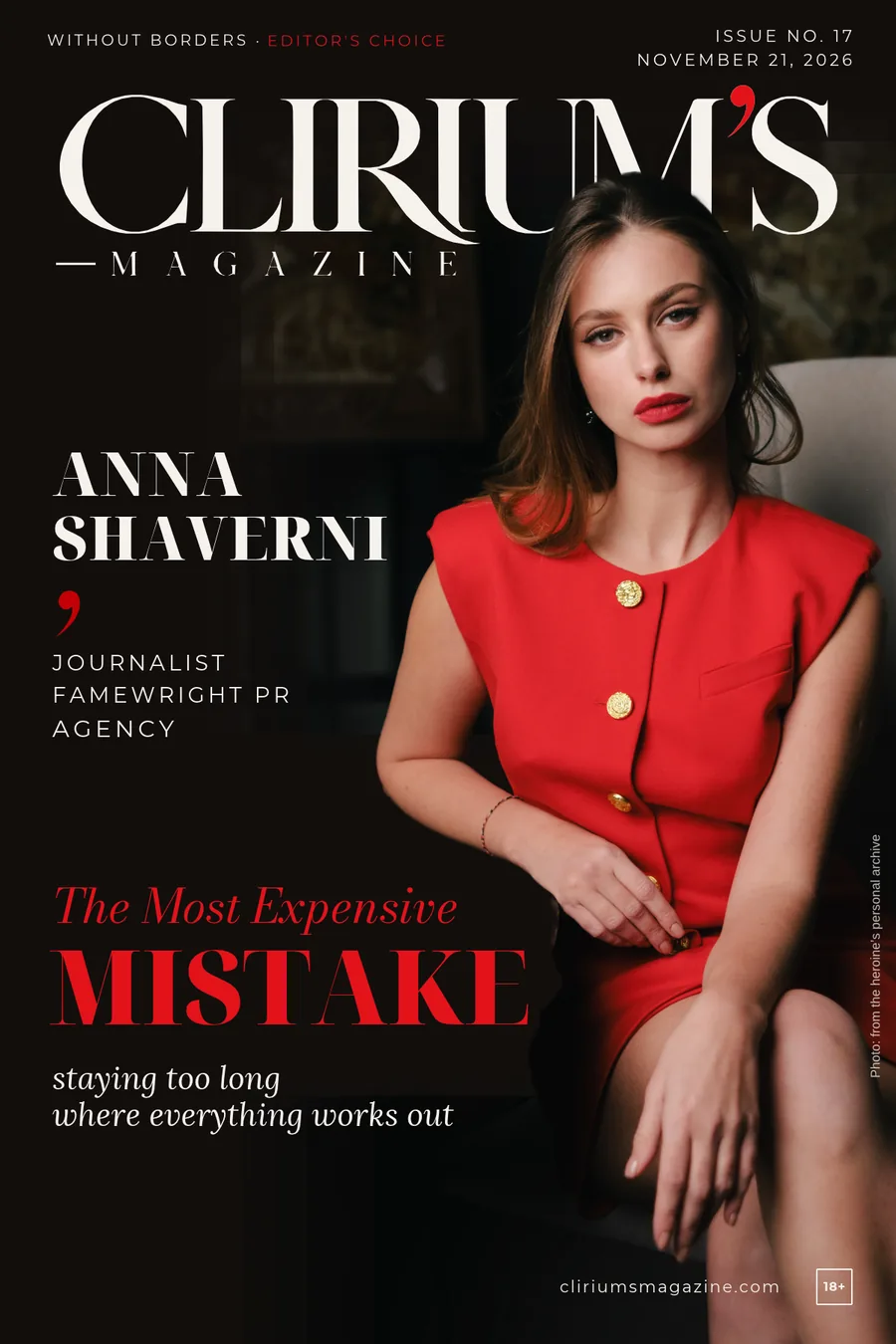

Anna and I met the way people who work with words probably should: in writing. I wrote to her agency suggesting they send us the stories of their clients—strong women who had built their own businesses or started their lives over in another country. Anna replied with questions, precise and businesslike, the kind only someone who has spent years in a newsroom would ask. And once she had the answers, she unexpectedly offered to begin with her own story. I liked that courage: a journalist who has spent her whole life asking other people questions, taking the interviewee’s seat herself.
When her answers arrived, I read them in one sitting. She is twenty-six, an age when many people are still figuring out where to begin, and Anna already has seven years of news journalism behind her—from radio to national television networks—along with a business of her own and travels to some forty countries. But what struck me was not the quantity; it was the quality of her gaze. She can look at her own life as soberly and with as much curiosity as she looks at the lives of the people she interviews—without self-admiration and without fear of admitting that not everything turned out neatly.
Anna gave her story its title herself—“The costliest mistake is staying too long where everything is going well”—and I decided not to touch it. For me, that sentence holds her whole essence: she is not afraid of difficulty; she is afraid of getting stuck in comfort. That is a rare and very grown-up kind of courage. Many of us know how to leave a place where things are bad; far fewer can leave a place where things are good but have grown too small.
I have long believed that a woman is bigger than any of her roles, and Anna is living proof: journalist, entrepreneur, traveler, someone who gathers people around her—and she refuses to fit entirely into any one of those roles. In this issue she speaks for herself, and I allow myself a few editorial comments, in the places where I wanted to pause and think it over together with you.
Founder, Clirium’s Magazine
Chapter 01
My Professional Path
First and foremost, I’m a journalist. I’ve always found people more interesting than their job titles—especially the decisions they make when there is no guarantee things will work out.
I’m a co-founder of the PR agency FameWright and of PrimeMedia Press, together with Ksenia Shaverskaya. My journalism experience includes work in newsrooms and interviews with entrepreneurs. My expert commentary has appeared in Forbes Russia, and interviews I prepared together with Ksenia have been published in Forbes Liberia.
What has always fascinated me is the gap between a person’s real achievements and how well known they are.
But there is a fundamental difference between making someone famous and helping them build a reputation.
Attention can come quickly. A reputation has to be confirmed by what you actually do.
— key points

Chapter 02
Seven Years in the News
You could say I come from a media family. My father is a journalist and producer who was nominated for TEFI, a Russian national television award. My mother works in marketing, and my sister is a video editor.
So television never seemed out of reach when I was growing up. I knew that behind a polished picture were people who sometimes stayed awake all night for three minutes of airtime.
Strangely enough, that was exactly what I wanted to do.
In my first year at university, I joined Monte Carlo Radio. Then came newsrooms in Kaliningrad and Moscow, news reporting, and internships at Channel One and Russia 24, two major Russian national television networks.
Altogether, seven years of my life were tied to news journalism.
It’s a profession that strips away illusions rather quickly.
In the morning, you are given a topic you know almost nothing about. Within a few hours, you need to find people to interview, arrange the interviews, organize filming, coordinate a camera operator, a sound technician and a driver, and write the script.
By the evening, you must deliver a finished three-minute report.
And nobody is particularly interested in whether you had time to understand the subject.
The assignments could not have been more different. One day you’re covering a French bulldog festival; the next, the MAKS international air show; then the opening of a new terminal at Moscow’s Sheremetyevo Airport.
I even once interviewed a gardener who worked for the Queen of England.
The interesting thing is that, in a way, the approach to all these people is the same. You have a few minutes to put a stranger at ease, understand what really matters to them, and find the question they will want to answer.
There was also one episode that made me seriously rethink what professionalism means.
In January 2019, a painting by Arkhip Kuindzhi was stolen from the Tretyakov Gallery in Moscow. I was an intern at the time. The reporter was having trouble with the connection, and I was put on standby for the live broadcast.
I was completely unprepared.
In the end, the connection came back and the reporter went on air. But I remember that feeling very well.
That was when I understood that courage and professional readiness are two different things.
News taught me to get my bearings quickly, make decisions, and talk to almost anyone.
But the most valuable skill that stayed with me is being able to hear when the person in front of you has slipped into rehearsed phrases.
The real story often begins after a question that wasn’t on the list.
— key points
Chapter 03
“Little Bows” and the Point of No Return
In fact, I realized quite early that I didn’t want to stake my whole life on one profession.
I remember a young woman I worked with during an internship at a national television network who was desperate to get a staff position there.
She had rented an apartment nearby with her last savings and spent months fighting for the chance to stay.
I watched her and thought about how tightly a person can tie her idea of success to one particular workplace.
It reminded me of a casino: putting everything on one color and hoping it comes up.
And I understood her ambition perfectly well. At the time, national television seemed to me the peak of a professional career, too.
You walk through the corridors of Ostankino, Moscow’s famous television center, and run into people you had only ever seen on screen. After your report airs on the evening news, friends start messaging you.
For a young journalist, that is truly impressive.
But gradually I started asking myself: what comes next?
Say I get the position I want. I make good reports and move up in the newsroom. Is that really supposed to become the main goal of my life?
I realized that even the most prestigious job is only a tool.
I didn’t want it to become the only possible scenario for my future.
There is also a particular genre in the news that Russian television people call a *bantik*, a “little bow”: a short, kind story at the end of a bulletin—about animals, unusual discoveries, interesting people. After it, the anchor usually smiles and moves on to the weather.
I made a lot of those reports.
And one day I noticed that I was constantly telling stories about other people’s adventures, while I had almost no time or money left for my own.
Alongside that, I was growing a blog, studying marketing, and working on personal brands.
The agency came about quite naturally. People who knew my journalism background began asking, “Anya, could you help me get published in the media?”
At first these were one-off requests. Then came referrals, new clients, more complex projects.
Gradually, Ksenia and I began building a team and a way of working.
I don’t think entrepreneurship began when the first client appeared. It began when I realized that I could decide for myself which projects I wanted to create and what responsibility I was ready to take for them.
Chapter 04
A First Million—by Twenty
By the age of twenty, I had earned my first million rubles from my own blog.
At the time, and by the standards of my life then, that was a very substantial amount of money—especially since I had started working at fourteen and was used to fairly modest earnings in journalism.
But the amount itself wasn’t what mattered most.
Until then, I had understood earning money in a fairly traditional way: you have an employer, a set of responsibilities, and a salary.
Here, nobody guaranteed me an income or handed me an audience.
I had to figure out for myself how to attract people, what topics interested them, how to build trust, and how to turn my own ideas into a product.
That was the first time I saw that you can earn not only with your time, but with something you have created yourself.
It really changed how I thought about work.
At the agency, the first real victory for me was referrals. When someone trusts you with their professional story, is happy with the result, and brings you the next client, that is the best sign you are doing something right.
Of the specific projects, I like to remember working with a data analytics expert. After a story in the Russian outlet Gazeta.Ru, six more publications picked up his commentary.
On another project, we helped arrange for a theater critic to attend an actress’s performance. A review followed.
I like results like these more than impressive-looking reach numbers.
A publication makes sense when it helps a person receive the professional attention they deserve.
Because fame on its own is a rather meaningless thing. What matters is what exactly people know you for.
Chapter 05
Vipassana: Five Days of Silence and One Cockroach
For a long time, I believed that being indispensable was a sign of professionalism.
If you want a good result, you’d better control everything. Delegate a task—check it. Check it—fix it. And sometimes it’s easier to just do it yourself from the start.
Eventually, you discover that you have built a business you can barely step away from.
My experience of Vipassana turned out to be very revealing: a ten-day meditation practice in complete silence, without a phone, books, or conversation.
I went to a dedicated center in Jakarta, the capital of Indonesia. Before leaving, I handed everything over to my business partner and my assistant.
For the first two days, I slept almost without a break.
I wasn’t meditating on higher things or going through a spiritual transformation. I just collapsed onto the bed and switched off at every opportunity.
And that was a rather unpleasant discovery.
I had always considered myself an energetic person who loves a fast pace of life. But only once I was without my usual tasks did I realize how tired I was.
On the fifth day, I left.
By then, the everyday difficulties, poor sleep, and unfamiliar conditions had piled up. The last straw was an enormous cockroach in the bathroom.
For someone who had come to learn to let go of control, it was a rather ironic ending.
But the most interesting part came after I got my phone back.
The agency had been working perfectly well without me.
Ksenia managed, my assistant managed. What’s more, on the day I came back, we signed a contract with a new client.
It was a useful blow to my ego.
It turns out your team can make decisions perfectly well without you. You just have to give people the chance to do it.
Since then, I try to tell two things apart: when a project really needs me, and when I simply want to feel indispensable.
I also realized that sometimes it is very important to stop in time.
Because you can get so carried away building your own freedom that, without noticing, you turn it into a new form of dependence.
You can get so carried away building your own freedom that, without noticing, you turn it into a new form of dependence.
— key points
Chapter 06
Life in Bali: When I Got Bored
My riskiest decision was probably my first solo trip to Bali.
I had a modest salary, my own blog, some savings, and a rather vague idea of the future.
But I really wanted to see how people live beyond the world I knew.
I spent four months in Bali.
At first, everything seemed perfect. The ocean, the sun, none of Moscow’s rush. No need to hurry anywhere, nobody demanding that I urgently redo a television report.
And then I got bored.
That was an unexpected discovery.
We often imagine happiness as a life with no more difficulties. And then we find that the absence of problems doesn’t yet mean life is interesting.
That was when I first thought that comfort can be just as dangerous as hardship.
When things are hard, you have to look for solutions. When everything is convenient, you can go for years without noticing that you have stopped growing.
I don’t want to turn life into a non-stop exercise in overcoming obstacles. But staying somewhere only because it is familiar and comfortable is a questionable strategy, too.
Since then, I have been to about forty countries.
And the more I travel, the more I understand that what interests me is not so much geography as people and their ideas of what a normal life is.
What counts as normal varies enormously from country to country.
In some places, people build careers until old age; in others, they know how to finish work at five and not feel guilty about it. Somewhere else, it is normal to change professions several times in a lifetime.
Observations like these make you reconsider your own beliefs.
Perhaps that is why travel has become for me not a way to escape reality, but a chance to see it from another side.
Comfort can be just as dangerous as hardship.
— key points
Chapter 07
How to Find Your People in a New Country
In a new place, a familiar circle of people doesn’t appear on its own. Social media and in-person meetings helped me.
The strangest thing about a new place is discovering that your former reputation carries very little weight. You may have years of experience, your own company, real professional achievements—but to people meeting you for the first time, all of that is still just words.
On the one hand, you have to introduce yourself all over again. On the other, there is a certain freedom in that: nobody knows who you were yesterday, and nobody tries to squeeze you into a familiar role.
Making friends, however, turned out to be unexpectedly easy. Probably because seven years in journalism had taught me to talk to complete strangers.
At first I met people through social media, and then the conversations moved to in-person meetings.
At some point I thought: if you want to get to know a certain circle of people, why keep looking for a way into someone else’s party?
You can throw your own.
Invite the people who interest you, introduce them to one another, give everyone a reason to meet. And it doesn’t have to be a big event. Sometimes dinner for a few people is enough.
I love watching people who didn’t know each other an hour ago find common interests, become friends, or start discussing ideas together.
In general, I think the ability to bring people together is one of the most underrated skills.
And in a new country, it is especially useful. You don’t have to wait to be accepted into a particular circle. It is far more interesting to gradually create your own.
Why keep looking for a way into someone else’s party? You can throw your own.
— key points
Chapter 08
The Price and the Support
I would start with my parents.
I was born in Riga and grew up in Kaliningrad. My parents always tried to show us the world, even when money was tight.
Sometimes they took out loans so we could travel as a family.
From the standpoint of financial discipline, that’s a debatable decision. But those trips gave me far more than beautiful memories.
From childhood, I knew that there are different cultures, languages, and ways to build a life.
Perhaps that is why it never seemed to me that a person must spend her whole life in one city or in one profession.
As for the price of my own decisions, for me it is above all time.
Our team works remotely, across different time zones. That experience has taught me to value people’s independence and trust within the team. It matters to me to keep time for the people close to me and for my personal life.
I have been very lucky with my business partner. Ksenia and I both came from journalism, so we share the same understanding of quality and can discuss work directly, without long explanations.
There is a team that makes decisions on its own.
And there is my husband, with whom I don’t have to prove anything.
When you are used to constantly striving for something, you especially value a relationship in which you are seen for more than your achievements.
Chapter 09
What Comes Next
I’m interested in the stories of founders at the intersection of technology, investment, and human psychology.
From the outside, the startup world looks quite glamorous.
A company raises several million dollars, investors believe in the idea, the founder becomes well known.
But I am far more interested in what happened before that news.
How many times was this person turned down? Why did they keep going? When did they first doubt their idea? And what turned out to be the hardest part after the investment came in?
Among the pieces published in Forbes Liberia is an interview Ksenia Shaverskaya and I did together with Rama Afullo, founder of the technology company Satlyt.
His seven-person team raised eight million dollars in investment. The company develops software that allows satellites to process data with artificial intelligence right in orbit.
Rama was born in Kenya, worked at major technology companies including Google and SpaceX, and then built his own business.
What interests me is not only the technology side of this story.
He pitched his idea to large companies, ran into rejection, and at some point decided to build his own product.
Stories like this let you see entrepreneurship without the usual gloss.
Going forward, I want to write more about people who create new technologies and change entire industries.
Among my long-term professional plans are my own projects and a media outlet of my own.
I would love to gather around it a large audience of people interested in entrepreneurship, travel, culture, and human stories.
And still keep room for a personal life.
Because at twenty-six, it is very easy to get carried away by the idea that right now you must build a career and nothing else, and everything else can wait.
I try not to make that mistake.
Chapter 10
Anna’s Rules for Life
Chapter 11
How to Change Your Career or Country: Anna’s Advice
First, I would ask her what exactly she wants.
Because sometimes the desire to move to another country really means a desire to change your life.
And those are not quite the same thing.
A move doesn’t automatically solve inner problems. You bring your character, habits, fears, and unresolved questions with you.
But you also bring everything you have learned.
When I was leaving television for entrepreneurship, it seemed to me that I was starting a completely different career.
But very quickly it turned out that almost all my previous experience was useful.
Talking to strangers, working with information, organizing processes, making decisions quickly.
So I would not advise devaluing your previous years just because you have decided to change direction.
And I don’t really believe in the advice “just don’t be afraid of anything.”
Fear can be perfectly rational.
It is much more useful to figure out what exactly you are afraid of, and prepare.
Calculate your expenses, learn the immigration rules, start learning the language, talk to people who have already walked a similar path.
Courage shouldn’t cancel out common sense.
But waiting for absolute certainty is pointless, too.
Sometimes it only appears once you start acting.
Courage shouldn’t cancel out common sense. But waiting for absolute certainty is pointless, too.
— key points
Chapter 12
The Story of a Name
The story of my name.
When I was twelve, my parents took us to France. On that one trip, we visited twelve châteaux of the Loire.
One of them, Château de Cheverny, stayed with me in particular.
Later, when I needed to come up with a pseudonym for social media, I chose Shaverni.
At the time, it was just a beautiful association with that trip.
But over time, the choice took on another meaning.
My father had also worked as a correspondent on national television. And when I came into journalism, I wanted to be seen as an independent author.
Not as somebody’s daughter. Not as a continuation of the family profession.
It mattered to me that people recognized me by my own work.
And so a childhood pseudonym gradually became my professional name.
Later, I started working on other people’s reputations.
There is a certain irony in that: I help entrepreneurs create their public image, and my own story began with an attempt to come up with a name.
I used to think the main thing was finding the right positioning.
Now I see it a little differently.
You can invent a beautiful name, a style, a visual image. But if there is nothing behind them, it all stops working quite quickly.
A name can be chosen in a few minutes. A reputation takes years to build.
I’m twenty-six, and I don’t think I already know all the answers.
I have experience I value, and quite a lot of plans that are still just plans.
I like the idea that a professional biography doesn’t have to be a finished story.
After all, I’m a journalist.
I always want to know what happens next.
A name can be chosen in a few minutes. A reputation takes years to build.
— key points
About the heroine
Anna Shaverni is a journalist and a co-founder of the PR agency FameWright and of PrimeMedia Press (together with Ksenia Shaverskaya). Seven years in news journalism: Monte Carlo Radio, newsrooms in Kaliningrad and Moscow, internships at Channel One and Russia 24. Expert commentary in Forbes Russia; interviews with entrepreneurs for Forbes Liberia. She has traveled to some forty countries. Born in Riga, raised in Kaliningrad.
Links are provided for reference only. This is not an advertisement: the magazine receives no compensation for publication.
- Role
- Journalist, entrepreneur
- Born in
- Riga
- Raised in
- Kaliningrad
- FameWright
- famewright.com
- PrimeMedia Press
- primemedia.press
- @shaverni.an
Links are provided as reference information about the heroine. This is not advertising: the editors receive no compensation for publication.
FAQ
01Who is Anna Shaverni?
A journalist and a co-founder of the PR agency FameWright and of PrimeMedia Press. Seven years of her career were spent in news journalism. Her expert commentary has appeared in Forbes Russia, and her interviews with entrepreneurs in Forbes Liberia.
02Why did Anna Shaverni leave television for her own business?
She realized early that she didn’t want to stake her whole life on one profession: for her, even the most prestigious job is a tool, not the only scenario for the future. The agency grew out of friends’ requests for help getting published in the media.
03How does Anna Shaverni find new friends in a new place?
Through social media and in-person meetings. In her words, sometimes it is enough to invite interesting people to one table yourself and introduce them to one another.
04Where does the name Shaverni come from?
From Château de Cheverny in the Loire Valley, which made an impression on her at twelve. Later, the pseudonym became her professional name: she wanted to be known for her own work, not as a journalist’s daughter.
Published with the heroine’s consent: the interview was given voluntarily, and the text and photographs were approved by her before publication. Heroine consents


Comments
0No comments yet. Be the first — share what resonated with you.
your thoughts