
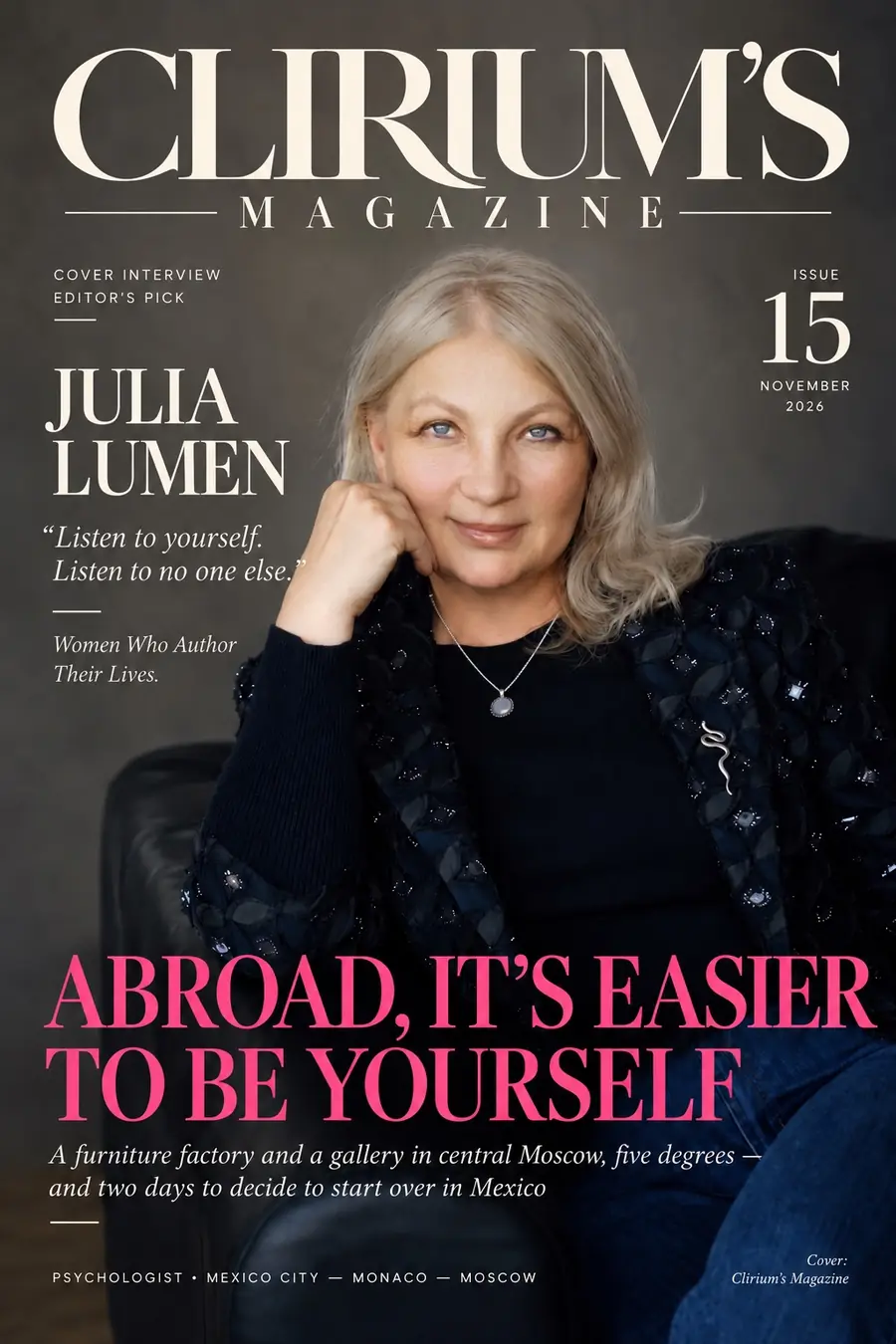

My husband introduced me to Julia. They have been friends for many years, and long before we first met I had heard so many stories about her that when we finally saw each other, I had the strange feeling of meeting someone I had known for a long time—and, at the same time, someone I had yet to get to know. I saw a woman with a very strong character, the kind of person who can really run a business, even more than one, and yet with a lightness in her voice and in the way she moves that you only find in people who have stopped trying to prove something to someone.
To me, Julia is first and foremost a businesswoman. She is very gifted, but what I see in her above all, and what I respect her for, is that she is a leader: someone who knows how to take responsibility for people, for money, for processes and, most of all, for her own life. I am convinced that only a leader can achieve anything in another country—where there is no familiar language, no old connections, no one to tell you what to do next, and where all you can rely on is yourself and what you learned while building something of your own.
When I laid her story out in a single line, it turned out to hold more lives than many people get in one: a musician trained in the final years of the Soviet Union, an entrepreneur of the 1990s, the owner of a full-cycle furniture factory and a design gallery on Frunzenskaya Embankment in Moscow, a student of five programs in three countries, a psychologist with thousands of hours of practice—and a woman who once decided, in two days, to fly to the other side of the world without a return ticket. A life on this scale almost invites a dramatic article about a woman who “left everything behind and started over”—and that is exactly what I did not want to write.
Because Julia never left anything behind. Every time a role became too tight, she did not cling to it, but she did not devalue what had been, either—she took everything she had learned with her and moved on, and that, I believe, is the most precise formula for grown-up freedom. I have long said that a woman is bigger than any of her roles—bigger than the role of “the one who has already made it,” bigger than the role of business owner, bigger than the role of the émigré who supposedly is too old to start over—and Julia’s story may be the clearest proof that this is not just a nice phrase.
In this issue Julia speaks in the first person, and I allow myself a few editorial comments—not to explain her story, but to mark the places where I, as an editor and as someone who knows well what such decisions cost, pause. “You know, my dear,” Julia says, “it is much easier to start your own business in a foreign country than in your own, because there it is easier to be yourself”—and this is where I would like you to start listening to her.
And one more coincidence that I don’t think is accidental: this issue comes out on November 1—Julia’s birthday. Let it be our gift to her and a reminder of how many lives she has already lived and how much beauty still lies ahead. Happy birthday, Julia!
From here on, she tells her story herself—in her own words.
Founder of Clirium’s Magazine · Creator of CLIRIUM®
Chapter 01
Julia Lumen
To be honest, I have lived many lives—really, many—and each of them was real, with its own work, its own people, its own victories and its own lessons, and I don’t want to disown any of them in hindsight, not even the ones that ended painfully.
Today I am a psychologist, and I work with people who feel they are not living their own lives: on the surface they seem to have everything, but inside there is a sense that they are standing in the wrong place. My strength is helping a person take their own place and remove what currently separates them from a happy life and from their dream—the obstacles they cannot see themselves, because they lie not in the conscious mind but deeper. I have been working in this field for seven years, and I have more than three thousand hours of practice behind me.
I don’t measure the result of my work in numbers or events, although events certainly happen: the result is when a person is happy because they are finally in their own place. That is my happiness, and the happiness of those who come to me.
But to understand how I got here, we need to go far back—to a country that no longer exists, and to a girl sitting at the piano who had no idea how many times she would have to start over.
Chapter 02
The 1990s: Starting From Zero
I received my first education in the Soviet Union, in its very last years, and I remember that time very well—the elections, the referendum, the feeling that the world around you was changing before your eyes and no one, not the adults, not the newspapers, not the teachers, knew what it would be like tomorrow. My first degree is in music; I am a pianist.
Then the 1990s came, and it turned out that nobody needed musicians. You could wait for everything to go back to the way it was, and many people did wait—for years—but I went into business right away, not because I had always dreamed of it, but because life put the question point-blank and I didn’t want to spend it waiting. That is how my first life ended and my second began.
Chapter 03
A Full-Cycle Factory and a Gallery on Frunzenskaya
In 2004 I built my own furniture production—a company called Intermebel, full cycle, from buying materials to installation in the client’s home. It was a small but real factory: machines, people, our own trucks, delivery, installation crews and a network of seven showrooms of our own, and I had to keep all of it in my head at once—production, sales, logistics, the team, money, deadlines—while remembering that behind every order was someone’s home, where people would live for years.
In 2018 came a design showroom and gallery in central Moscow, on Frunzenskaya Embankment, and it was no longer just a place that sold furniture: we held events and exhibitions of contemporary artists there, and the gallery became a space where art, design and people who care about how they live came together.
In a word, everything I did back then was about beauty, comfort and a good life. And I suppose the music in me never went anywhere: instead of music, I was creating spaces that are good to live in.
Everything I did was about beauty, comfort and a good life.
— key points

Chapter 04
Commentary by Victory Naydenova
Chapter 05
Five Degrees, and None of Them Just for Show
I have five different degrees, and I didn’t earn a single one of them just for the diploma: each time I went back to school because my work demanded new knowledge, and pretending I already knew everything would have been too costly—both for the business and for the people who depended on me.
When the business needed serious financial management, I earned a degree in financial management; when it needed promotion, a degree in marketing. Then came business school in the United States and Russia’s Presidential Management Training Program, which took me to Germany, and together all of it gave me an understanding of how work should be done and how to build a business that rests not on a single person but on a system.
And when I realized I would be winding down the business and moving into psychology, of course I earned a university degree in psychology. For me it was just as natural as finance once was for the factory: if you are going into a new field, you go in with a foundation, not just with a wish.
Chapter 06
The Mistake That Taught Me the Most
My biggest mistake was the time when I tried to be someone other than myself. I played someone else’s role, occupied someone else’s place, and at some point I somewhat forgot who I really was, what I wanted and where I was going—and from the outside, probably no one noticed, because on the surface everything looked perfectly fine.
And it was truly painful. The body turned out to be more honest than the mind: my health began to fail, an illness appeared, and that is what pushed me to take up work with the psyche and the body in earnest.
Although, to be honest, I no longer think it was a mistake: it was a path that led me to where I am now. If it hadn’t been for that so-called “mistake,” in quotation marks, I would have stayed where I was—running the business and living in the same place—but something collapsed, something fell away, I became disillusioned with some things, and I found myself in a completely new life.
But I don’t recommend doing it this way: it is painful, frightening and very unpleasant. If you feel that the old ways no longer work and something in your life is off, it is better to find a good specialist in time and take an honest inventory—where you are going the wrong way—so that you come into the new voluntarily, not through pain.
If it hadn’t been for that “mistake,” I would have stayed where I was.
— key points
Chapter 07
Commentary by Victory Naydenova
Chapter 08
How I Found My Calling
After that illness, I started with myself. I needed to understand what was happening to me and why my body was protesting so loudly against the life I had built for myself, and I took up work with the psyche and the body in earnest: I read, studied, experimented, looked for specialists who could help me—and step by step I came back to myself, to the woman I had once lost in someone else’s role.
And somewhere along the way I noticed that I had started to see in people what they could not see in themselves. You talk with someone about their work, their exhaustion, their relationships—and suddenly you understand very clearly what is really holding them back and where they turned off their own road. At first I didn’t attach much importance to it, but these moments kept happening again and again, and the people I shared them with would come back and tell me that something had shifted for them.
And then COVID happened. Many people simply couldn’t cope—with uncertainty, with loneliness, with fear—and while I was still running my business, I helped them a great deal as a volunteer: I listened, supported, and helped them see a way out where it seemed to them there was none. Then friends began to come to me, then relatives and friends of friends, then people who had been referred to me, and gradually what had been help “on the side” became my main work.
I saw that my work was changing lives—not in theory, but right in front of me: people who came to me at a dead end began to move, dared to do what they had long been afraid to do, built relationships and moved to new countries. That became my point of no return: once you understand that you can help a person see what they cannot see themselves, you simply can’t stop doing it. That is when I decided to wind down the business and move into psychology—and, as I said, I went back to school so that I would come into the new work with a foundation, not just with a wish.
Once you understand that you can help a person see what they cannot see themselves, you can’t stop doing it.
— key points
Chapter 09
What I Do Today
Today I am a psychologist, and I work with what a person cannot see on their own. People come to me who feel they are not living their own lives: they seem to be doing everything right, yet what they want doesn’t come; somewhere they took a wrong turn and don’t understand where—and very often what holds them back lies not in the conscious mind but deeper, in the subconscious, where you can’t look without a guide, because from inside your own life you simply can’t see it.

My task is to see these obstacles together with the person and help remove them, so that they can take their own place—in the family, in their work, in their own life—and move toward their own dream, not someone else’s. I work with both the psyche and the body, because I know from my own experience that the body is often more honest than the mind and is the first to show that a person is living someone else’s life. I also understand business from the inside very well—for almost twenty years I ran production, people and money myself—so with entrepreneurs we speak the same language.
Today I have seven years of practice and more than three thousand hours of work with people behind me.
The result of my work is not individual events, although they happen all the time: a person dares to make changes they haven’t dared to make for years, builds relationships, changes professions or countries. The main result is when a person becomes happy because they are finally standing in their own place and living their own life, not someone else’s. I see such stories every day, and they are what give me confidence that I, too, am finally in my own place.
I work with what a person cannot see on their own.
— key points
Chapter 10
Two Days and a One-Way Ticket
After the pandemic, I made the riskiest decision of my life in literally two days: I decided to move to Mexico. I flew there without a return ticket—and stayed, living there for a year and a half.
It was hard, and I won’t pretend that decisions like that come easily, but at that moment I simply couldn’t have done otherwise. For the first time I made a decision with my heart—the way I felt, not the way it would have been right according to someone else’s ideas—and now I understand that it was the hardest and the rightest decision of my life.
Since then I have trusted myself and my intuition, and that is how I make every important decision.
It was the hardest and the rightest decision of my life.
— key points
Chapter 11
Mexico Is Another Planet
Living in Mexico greatly expanded my idea of life in general. Mexico is a bit of another planet: a different mentality, a different climate, different relationships between people—and you suddenly feel like a small child discovering the world all over again; after the factory, the gallery and five degrees, that is a very unexpected and very valuable feeling.
I am a sociable person, and I found my people there fairly quickly. Mexico showed me how differently life can be arranged and how much it means to a person simply to be heard and accepted as they are—and this greatly enriched my work: there I saw in a new way how much a simple connection with one’s own body means to a person. Mexico expanded me enormously and softened the categorical edge of my judgments, and for a woman used to running a factory, that is a very big gift.
What is hardest? Spanish. I just can’t learn it: I already understand a lot, but I can’t speak—and, to be honest, I don’t want to study it; Spanish is a real problem for me, and I have made my peace with that.
What is easiest there is the people: it is very easy to connect with them, they treat Russians wonderfully, and in general everything is much simpler and more accessible than, say, in Moscow. Even though Mexico City is a huge city of twenty-five, if not thirty, million people, everyone there is somehow laid-back, and in that sense Mexico is, of course, wonderful.
Chapter 12
Mexico City, Monaco, Moscow
These days I spend part of the year in Mexico, part in Monaco, and I come to Moscow for the summer. Right now, for example, I am visiting a friend in Tbilisi, and it is absolutely wonderful here too—I am happy.

I am a traveler, and I live in different places. I jokingly call myself “of no fixed address, MMM edition”—Mexico City, Monaco, Moscow. I don’t have a permanent home right now, and I really like it: my life used to be tied to the factory, the showrooms and the gallery, and now my home is wherever I am.
I jokingly call myself “of no fixed address, MMM edition”—Mexico City, Monaco, Moscow. And I really like it.
— key points
Chapter 13
Commentary by Victory Naydenova
Chapter 14
To the Woman Who Is Afraid to Start Her Own Business
You know, my dear, it is often much easier to start your own business in a foreign country than in your own, because there it is easier to be yourself: you don’t look over your shoulder at what your relatives and friends will say, and you don’t torment yourself with the question of whether it will work out or not.
You start from zero—as if you had just graduated from school and college, and you have the luxury of trying. So just try. Trust, ask for help, believe—and be sure to act, because without action neither faith nor trust will work. I know this from my own experience.
Abroad, it’s easier to be yourself: you start from zero, and you can try.
— key points
In Short
Julia’s Rules for Life
in brief
Julia’s Rules of Life
Published with the heroine’s consent: the interview was given voluntarily, and the text and photographs were approved by her before publication. Heroine consents


Comments
0No comments yet. Be the first — share what resonated with you.
your thoughts